Friday, February 25, 2011

Audi's New Strategy

After a long blog post hiatus I have returned to the world of the living...well to the living world of the blogosphere. A few other writing projects pulled me away and leeched what little free time I had from my little journal here. Those projects are not yet completed but I would be remiss if I did not have at least one ad commentary post related to the better Super Bowl Ads for this year--even though it is kinda late.

Standing in a bar for the entire duration of a football came can be kinda tiring for some, but not for true fans of a "Super Bowl Experience" lots of drinks and food everywhere, Packers and Steelers fans alike griping and cheering in unison. Football season's grand finally was punctuated with a few really impressive commercials this year. As I'm sure you can tell from the title, it was Audi for the win, at least in my book.

In case you haven't seen it, here's the commercial:


Pretty funny right? Humor is one of the best ways to deliver a message and get people to remember it. But just what was Audi's message?
"This isn't your Father's luxury"

This message is communicated in 3 ways 
(1) the cast 
(2) the action 
(3) the dialog

The Cast
Kept in these amazing prison cells are the vestiges of Old Luxury, opulent rugs, decadent crystal, gaudy chairs and old people. I mean the true to life stereotype of what most of us consider the "Rich Old Bugger"--heavily wrinkled with white hair, just like Ebenezer Scrooge. The people we characterize as heartless, out of touch, and impractical stand behind gilded bars as 2 of the prisoners try escaping--one of whom is "The New 50" (handsome, grey haired and on the move). He's the one Audi wants us to identify with, mature--not old, smart, stylish and full of passion for life. Much like the way they want you to see their cars.

The Action
Escaping from this prison doesn't seem to be all that difficult (hint, hint). But the duo do have to break through a window. The dapper escapee is pretty agile going through the window while the typical bugger has to bumble though the opening. Its not just for comedic relief, the cat like reflexes and smooth style of the dapper escapee hearken right back to the main message "Your father couldn't/wouldn't but you can/will". It makes our subconscious believe that we are better than our parents somehow and so, we would want a better car, one just as action oriented as we are.

The Dialog
When the pair finally get outside, the typical bugger chooses the Mercedes because "his father had one." The dapper escapee chooses the Audi. How does he know it's a trap? Again he's smart. He knows that the typical bugger would be fooled into thinking that luxury only existed only in the backseat of a Benz. Oh but not Mr. Dapper, he knows what Audi wants us all to know after watching this commercial--luxury is a choice. The Audi driver chooses to drive himself, he has no driver, he doesn't need to depend on anyone. He makes his own decision based on style and preference, not on legacy.

For such a simple 1minute spot, Audi managed to embed an image in its viewers that will start to chip away at the crag of established luxury. Instead of attacking quality, styling, efficiency or some other typical aspect of determining car supremacy, they picked a stance that aligned them with one of the most famous high class car companies in the world and said simply "Luxury is your choice, choose wisely"

Monday, November 29, 2010

The Top 10 Uses for Twitter

I was late to jump on the Twitter bandwagon. To be honest, I didn't understand why anyone would want to post text message style updates to a blog format for other people to read. A former boss of mine convinced me to try it out before I wrote it off and thanks to him I was immediately hooked.

For a period of around 6 months, I was tweeting several times a day. At first is was all the regular boring stuff like "I'm hungry" or "Watching day time television, I heart Maury" ok so the last statement was a lie but I was another one of those useless twiple (twitter people) that babbled on about nothing until I started following people who actually had something to say. I felt bad that I didn't have anything to say so I stopped talking about what I was eating for lunch and started talking about design and movies and sharing opinions/information on topics that other people might find relevant. That opened up my world and I wanted to explore more uses for this blub-blog phenomenon.

So without further ado and in no particular order, here's the list:

1. Breaking News
Because of Twitter's constant stream of information, it's practically a news wire. Reliable and questionable sources alike post "news" from around the globe on a 24hr basis, in some instances a big story may break on Twitter before the anchors behind the desk at CNN even get a flash. Realizing this Twitter actually has a thread set up just for getting the latest news. If you like to be in the International-Know then you may have hit the jackpot.
 
2. Link Sharing
This was one of my favorite parts of Twitter. Since I followed a lot of designers, they were always sharing links to their latest work, good inspiration places or just free stuff. It can take a lot of time to root out good, free, design resources online, but with someone practically spoon feeding it to me, I had more time to focus on work and my blog. Even if you aren't in the market for information, link sharing can benefit your business by driving traffic to your site.


3. Corporate Communication
One of the companies I follow on my twitter account is Popeye's chicken. I know it sounds silly but they're one of the few national chains who are using Twitter effectively as a means of corporate communication. They engage customers in "conversation" and announce special deals online that are too time sensitive for an email or similar campaign.


4. Trend Alerts
In case you aren't all that familiar with Twitter, there's something called a Trending Topic that indicates what most people are talking about right that moment. People who's jobs depend on "keeping their finger on the pulse" of something or other can and usually do make good use of this feature. Anything from which person most people are considering casting their vote for on American Idol to World Series favorites can be found within the millions of tiny posts happening every second on Twitter.


5. Networking
Connecting to people and having them connect to you is what networking is all about. Twitter makes it easy for you to link up with potential customers, clients or business partners and see what's going on in their world. Making yourself more involved can pay off...big time. 

6. Creating Specialty Communities
 If you like gardening, you can follow a bunch of accomplished gardeners, a local greenhouse, a plant nursery, and an organic seed company if you wish to create your own little news feed of things relevant to you. Twitter allows you to personalize lots of mini news feeds for all your different interests.

7. Job Pulse
Finding a new line of work or hiring a new employee with Twitter has become so popular that instead of just searching for the tag #jobs an entirely separate search engine has been created to help jobseekers find gainful employment.


8. Personal Branding
One of the things that creatives do well is personal branding. Writers, photographers and designers are all using twitter to stay in touch, share their work and promote their personal brand. Everything from the way they write their tweets to the profile background speaks volumes. If you are your business, hype you, and let Twitter do all the heavy lifting.

9. Live from New York It's....
Twitter has the ability to provide great play by play action, whether its a football game or a conference. Because of its brief and immediate nature--and the fact you can tweet from your phone--live "simulcast" accounts of events can be given with ease.

10. Sell
After my journey of self discovery with Twitter, I finally found its best use for me--selling. I design a line of Anime inspired Tshirts and since most of my followers were interested in the same things, I started posting links to my Zazzle Store for people to check out my new creations. It actually boosted my sales a bit and it didn't cost me a penny.

After all the nice things I've said about Twitter, I should add that I logged in just a few days ago for the first time in almost two months. Which brings me to my next point, if you decided to use Twitter for a business reason, don't follow my example, you have to make a continuous schedule and stick to it. To have an abandoned and dilapidated twitter account connected with your business speaks volumes, negative, negative volumes.

Additional Reading (Articles are from 2007-2009 at the hieght of Twitter popularity)

The Top 5 Ways Smart People Use Twitter

17 Ways You Can Use Twitter: A Guide for Beginners, Marketers and Business Owners

Top 10 Uses of Twitter


Monday, November 22, 2010

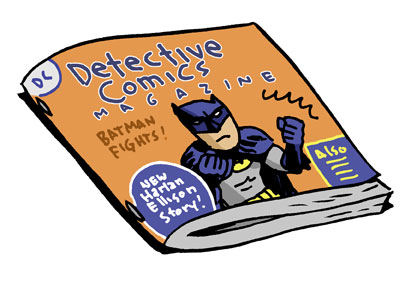
Lessons from the "Great Detective"

http://www.bigtimeattic.com/blog/
I've been a Batman fan since...well since the 90's. Other kids were aspiring to be like Superman when they grew up--practically invincible with a Kirk Douglas chin--I on the other hand was drawn to the mysterious allure of the Dark Knight. There was something about his melancholy and generally disinterested attitude toward others, his "gray area" moral standards, and his uncanny ability to be reborn an infinite number of times within the DC Universe only to have another area of his complex psyche become the focus of  new comic, movie or animated series.

There are a lot of things that can be learned from everyone's favorite Vigilante Playboy--like money can't buy happiness or women in leather body suits can't always be trusted--but did you ever stop to think that Bruce Wayne could teach you a thing or two about...marketing??

Be a Detective
Batman has been referred to by a lot of names, and with Christian Bale dawning the Cape and Cowel most recently in the Dark Knight film, people tend to forget that even though The Batman is a heroic figure for justice, in his essence, he is a detective pure and simple. With no superpowers, psychic ability or even a Steven Hawking rated IQ, he manages to solve crimes and apprehend criminals by use of his sheer intellect. How? Partly by paying attention.

It sounds simple enough but paying attention when it comes to marketing is hard work and takes a lot of time. There are 3 main areas that should always have your attention:
  1. Your customer's demands
  2. Your competitor's service
  3. Your own efforts
You'll find that if you pay closer attention to customer demands you will identify ways to improve your product or service. If you keep tabs on your competition, you can keep up more easily with trends in the market or even simple sales promotion. If you scrutinize your own efforts you'll know what you're doing now, what you've done in the past, what works, what doesn't and what you might like to try. Now that you've armed yourself with information you can conduct business more effectively.

Some people call it Market Research, but it's really just detective work. Just pay attention, gather information, then put the pieces together to create a personalized marketing plan. It's a simple notion that will pay off in the long run with the right amount of hard work.

Have a Database
In the Batcave there is a giant computer. Batman's database. Since he isn't super-human, there's no way he could be expected to remember all his case notes or analyze compounds just by looking at them--that's what his tech is for.

Ok, so you've started paying attention to your business surroundings. You have your notes and your ideas about how this puzzle should fit together. Now what? Make a database. I use the term loosely to refer to any collection of information...not just spreadsheets and forms. Its important to organize what you've amassed into something useable. Have a lot of business cards you've collected from clients or prospects? Scan them and create a computerized version of a rolodex or go low tech if you don't want to spend the money on new software and just type them up and save an electronic file. Know about competitor promotions? Make up a calendar detailing the dates then put your information in right beside it. Whatever it maybe you've collected, turn it into something you can use.


Even Loners have a Support Staff
It's no secret that while Bruce Wayne may have been the outgoing type, Batman was decidedly less...amiable. But despite his gruff nature he still managed to have helpful friends. Justice League aside, Batman had his faithful butler Alfred, crime fighting companion Robin and eventually another sassy compatriot Batgirl, to help out (even though he acted like he could handle it all on his own, regularly).

Sometimes marketing can be too big a job for just one person, or it may be the case that what you're doing is outside of your realm of expertise. That's ok, just ask for help. If you decide that you want to send thank you letters to customers who purchased from your new holiday catalog but you aren't a very good writer--ask for help. If you aren't sure what kind of commercial you should have to promote your car dealerships 4th of July sale--ask for help. If your latest product has customers beating down the door to buy and you can't possibly fill all the orders yourself--ask for help. Help can come in the form of a friend, colleague, family member or paid professional. Use the resources available to your advantage, there's no shame in asking for help--especially when it will lead to greater business success.

Other than having the best array of villains of all time, Batman can--and does--teach us a lot about ourselves and the world. Smart decisions are made with good information, working smarter means a better use of your tools and British butlers are the best at keeping secrets. Maxims to live by for one and all.

Monday, November 15, 2010

F-Word Marketing: The 10 Minute Summary

This post was inspired by one of my favorite authors on the subject of marketing, Jay Conrad Levinson. In one of his books he talks about the F-word. "F" meaning Free. He goes onto elaborate on all the free things a guerilla marketer can do to boost their business, several pages worth excellent advice, and well worth the read. However if you don't have the time, or the book, you can take a look at my little summary that should only take you 10 minutes to read, that is if you don't stop to take notes...

People
Let's stop to think for a moment. Seeing as how this post is coming out around the holiday season, I'm sure there have been a lot of school fund-raising catalogs floating around your office. Ever stop to think why? Because its easier to ask someone you know to buy stuff from you than someone you don't.

A parent helping their kid out with sales is going to start with their "inner circle"--friends, family and co-workers at they are on generally friendly terms with. Levinson reminds us that it doesn't cost a penny to market to these people, often a simple conversation is enough to turn them into a customer. And if they are a happy customer, guess what? The will tell other people. People who might give you a try because they are on generally good terms with the person who recommended you. The power of people is often underestimated or completely over looked but always remember, no people, no customers. No customers, no business.

Information
The Internet has spoiled and entire generation of people, myself included, into thinking that if you look hard enough, you can get pretty much anything for free. While that is true to a point, and the quality of said "anything" can be highly suspect at times--the real issue is people like information, free information. If you give out free information, people might like you too, or at least like your business.

But you can't just give out lists of the most common pet names of the last year or stories about your Aunt's bunions and expect people to want to hang around. Free information has to follow some guidelines:
  1. It has to be useful
  2. It has to be current (especially with facts and figures, anything over 5yrs old is considered out of date)
  3. It has to be relevant to your customer's problem/situation
  4. It has to be easy to get to, read and pass on
Basically, if you're going to give out free info--say on your website or in the form or a monthly newsletter--make it so good people will think they should be paying for it!

Keystrokes
Keystrokes are free! Well, they are after you buy the computer. So maximize your investment by:
  • Starting a blog-its another great way to share information for free, like I'm doing right now
  • Creating a newsletter-perfect solution for online retailers because it allows you to announce sales and specials without spending money for a direct mail campaign
  • Being social--and by that I mean social media. Advertising on Twitter and Facebook may cost a few bucks here and there but user accounts are free so use them to stay in touch with customers, announce specials, or create a community around your product/service
I'm sure if challenged to, you could come up with more marketing tricks that are 100% free than I have listed here. Good. Think hard and write them down then do them. A good marketer doesn't always need money to spend, just a little time and elbow grease. Reading this post should have taken up only 10 minutes of your time (maybe less!) so there is plenty left over for you to get to work. Good Luck and may the F-word be with you.

Sunday, November 7, 2010

3 Things I Learned from Fishing that I Should have been Taught in Marketing.

I really like to fish, sort of. I guess I wouldn't consider myself an avid fisherman but there is something very relaxing and zen-like about standing on the shore under the sun just waiting. Waiting for the moment when you get a bite. The exhilaration of that singular moment and the thrill of the catch is enough to keep hundreds of thousands of people coming back...its also enough to support an entire network devoted completely to fishing.

While I was standing on the shore with my Partner in Crime I started to think of all the little things we do when we fish. It then occurred to me that it would make a great blog, if I could only find the time to write it...


Be Persistent, Be Patient
This has got to be like the Number 1 rule of fishing, one that I usually forget. I'm always in a rush to get out on the water and start reeling 'em in and after about 15 minutes of waiting with no bite, I'm usually convinced that there are no fish and I want to pack up and go home. My partner, however, always plans to wait a few hours and spend all day at a fishing hole if necessary. He's there for the long haul and knows that it takes time to find the fish then convince them to bite. Patience and Persistence wins every time, he always catches the most fish.


This principle is one of the keys to marketing. Marketing is not instant. It takes time. People, like fish, have to be massaged into wanting your "bait." They need to see it enough times, be comfortable with it and decide, "this is an offer I can't pass up!" then you hook 'em. It could take an hour before you get that first bite or it could take a month, but if you prepare your plan with the long haul in mind, you'll catch a lot more fish than your opponent.


Change your Bait
I'm sure you've seen a fisherman's tackle box before (or at least wandered down the fishing supply aisle in a Wal-Mart at least once, even if by accident) and noticed all the odds and ends. There is a reason for the multitudes of different bait out there. Quite simply, different fish like different things. I'm sure each company that manufactures these little plastic miracles puts a lot of work into figuring out the psychology and physiology of the fish they were aiming to entice with their lures--but I just buy what I think will work. I buy things that I think are pretty, lures that I don't have and ones that I see other people using on TV. I try them all and keep what works and put the others aside. You never know what a fish will jump at so you have to be prepared with options.

Having a "marketing mix" is an important way to start your first efforts. Since you don't know what will work for you, its best to try as many things as you can afford (and reasonably execute). As time goes on you'll find out, through response tracking, where the bulk of your customers are coming from. Once that becomes clear, you can stop sinking money into marketing that produces no returns and double up on your winning "lures."


"You Don't Catch Bass with a Bream Hook"
When I started fishing again as an adult, I just thought a hook was a hook and you just tie it to some line and throw it in the water with some bait on the end and that was that. Wrong. I was quickly informed that you "don't catch bass with a bream hook" meaning you have to know your target and use the appropriate tools to catch them. I could put that tiny bream hook in the water with a hundred hungry big mouth bass and would have missed every one of them. Why? Cause you need a heavy duty hook for a heavy fish.

Knowing your target is where most marketers have their biggest problems. If you don't have an accurate cross section of your customers then you're liable to waste time and money trying to entice people who weren't in the market for what you were selling in the first place. Once you know who you're marketing to, the next step is to make sure your "hook" is the right one. Dangling a foreign sports car in front of a customer base over the age of 70 may seem like  good idea, after all they probably have more disposable income than a college student or young professional, but in all reality the likely hood that they would actually bite is pretty slim. Don't believe me? Just take a look the next time you're out for a drive, you won't see too many Maseratis outside the lodge for bingo night.

The Zen of fishing is pretty educational and if you're a small business owner responsible for your own marketing, I suggest you take a day off, head down to the lake and just stand on the shore for a few hours. You'll learn a lot about yourself, your dedication and whether or not you have what it takes to really "catch fish."

Monday, June 28, 2010

Signs 101: An Introduction to a Tricky Medium

Since I own a sign shop now, I wanted to take the opportunity to educate the readers of my tiny blog about this tricky medium. I see a lot, a lot of bad signs daily so I wanted to discuss the good, the bad, the ugly and more in this three part series. Lets get started shall we?

What is a Sign?
 "A sign is an entity which signifies another entity."--Wikipedia. A sign can be as small as a flyer or as large as a billboard. Regardless of its size, signs should always have (1) an intended target (2) a decided goal  (3) a clear message.

Primary Goals of a Sign
Signs can inform. An informative sign can announce holiday hours, new management, a new location, a grand opening, basically anything you would like to tell another person. Signs can label. Using a sign as a label is a pretty common occurrence since they label a store front, an entrance, an exit, ect. Signs can solicit a response. We've all been traveling on the highway at one time or another and have seen the big "EXIT NOW" signs. These are they types of signs you'll be most likely to use, compelling your customers to call or visit or buy.

Diagram of a Good Sign
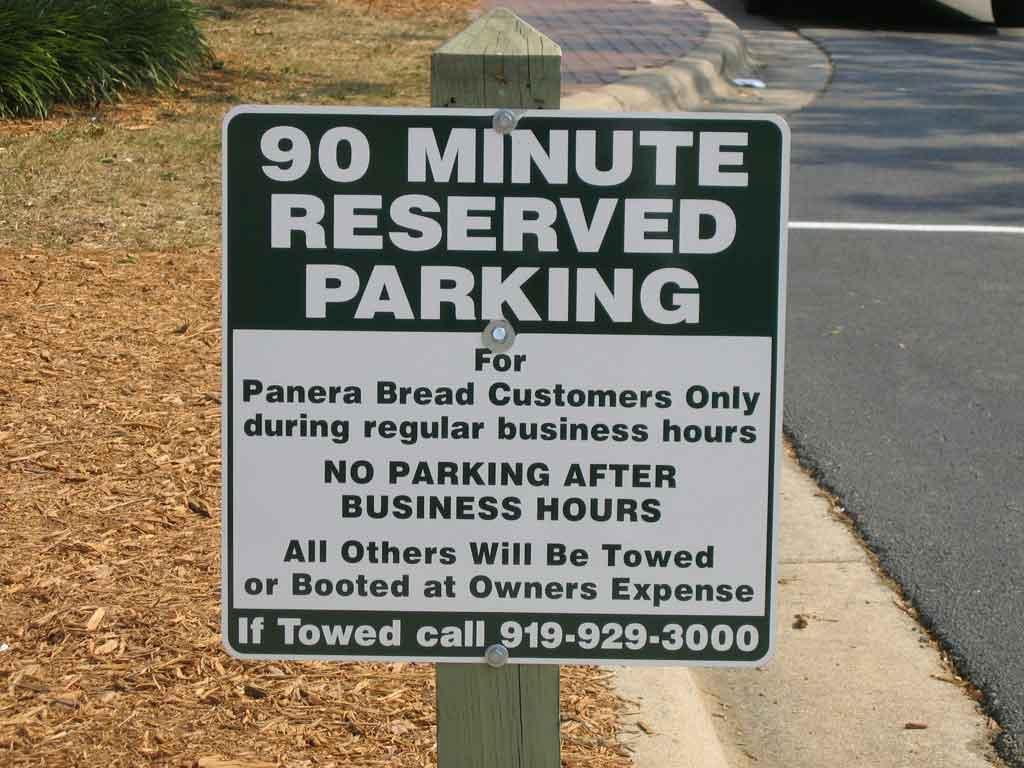
A good sign is composed of 3 good qualities. (1) Clear Title (2) Legible Instruction (3) Contact Information. Using the sign to the left as an example, lets go through the qualities one by one. A clear title refers to the headline of a sign. The headline should always be the main point you want to communicate to the reader. You can never fully count on the fact that a person will read everything you have to say so get to the point and get there as fast as you can. Looking at the sign to the left, you can figure out the gist of the sign without having to read the whole thing: "reserved parking" for customers only. Read on a bit and you get to the legible instruction. The sign tells you clearly when you may and may not park in this space. If you are not a customer and it is after business hours, you better get lost. Lastly, contact information is important. Never forget your contact information, especially if your sign is soliciting a response. Phone numbers are the most common and should be second biggest piece of info on the sign after the title.

Hallmarks of a Bad Sign
  • Conflicting or distracting colors
  • Illegible fonts
  • No clear headline or title
  • Too much information
  • Too little information
  • No contact information
  • Confusing symbols or images
  • Letters too small
  • Poor arrangement
  • Useless information or symbols (one of my biggest pet-peeves is when people start a sign with WOW! as an attention getter instead of getting to the point)
The next two installments will be about signs for advertisers and designers. Same bat time, same bat channel!

Tuesday, June 22, 2010

How to Use Craigslist Right, in My Opinion

My first foray into guerilla marketing started a few months ago when I picked up an awesome little book by Jay Conrad Levinson. I read a lot about his thoughts and practices but never actually put his good advice to use until I started my sign shop. Mr. Levinson is a big cheerleader for classified ads and acknowledges the growing popularity of online classified ads as a money saving alternative. By far, Craigslist is the most popular online classified site, but navigating the spam laden beast to get any true value from it takes some doing. This post is to share some of what I've experienced in hopes of saving you some time and effort.

Intro to Craigslist
"Craigslist is a centralized network of online communities, featuring free online classified advertisements – with sections devoted to jobs, housing, personals, for sale, services, community, gigs, résumés, and discussion forums."--Wikipedia
Its very similar to the Sunday classifieds that run in your local paper, only there is no cost for most listings and the viewer ship of craigslist pages is in the hundreds of thousands--even millions in some cases. Check out the Factsheet for more about Craigslist.org.

Writing Your Ad
Classified ads are meant to be brief by nature so get to the point. If you are a dog groomer, make "dog groomer" your post title not something like "Time to Love Fido Back". When looking through listings, people scan for pre-determined keywords in their brain. Make your title 7 words or less and frank.

The first line of your ad is where you engage. If some one is reading your ad, that means they clicked the link. If they clicked the link, you can be fairly sure that they are interested in what you're selling. Now you can talk to them:
  • Briefly explain your business or service
  • Pick three or fewer points to highlight (i.e. no minimum order, same day delivery, etc.)
  • Provide contact information and business hours
  • Make a call to action (i.e. call now for a free quote)
Choosing Your Category
Craigslist has 11 main categories. The ones you will be most likely to post in are "service offered" and "for sale." You have to choose your sub-categories wisely as Craigslist reminds its users to "Please post to a single geographic area and category only -- cross-posting to multiple cities or categories is not allowed." The categories are pretty self explanatory, but you can always use Craigslist Help if you have questions. However, the easiest way to determine if your ad belongs is to read some of the others in the category you're thinking about posting in. It will also help you to determine what makes a good ad and what makes a bad one.

Measuring Results
I post in 7 different categories on Craigslist. Since I've only been at this a month, I'm still in the process of collecting accurate measurements on which categories bring me the most real traffic (as opposed to SPAM). One of the most accurate ways to find out where you're ad is doing the most good is variation. I only post ads about banners in the "skilled trade services" category. Ads about coroplast yard signs are listed in "general", ect. When I check my messages I look at what the person is asking for. So far, my banner ad in "skilled trade services" is working the best. You can adapt this approach to fit your situation even if you don't have varying products to sell. If you offer a different incentive in each ad (i.e. free consultation, 5% first order, ect.) you can track the successfulness of your ad just as easily.

Beware... SPAM!
SPAM is still a big part of the internet and, unfortunately, a big part of Craigslist. While the site does take precautions to help cut down on fake posts and web bot solicitations of posters it does still happen. I get around 5-7 SPAM emails per post. The most common are people emailing me links to other sites where I can "post my item for sale" or scammers trying to get me to agree to bad money order transactions. I never click any link sent in a Craigslist email, it could be a Pandora's box. I also spot scammers with a few easy flags:
  1. Misspellings
  2. Poor grammar like the writer is not a native English speaker
  3. False greetings like "hello ma'am/sir"
  4. Short messages saying they are "interested in my item" but give no other detail or information
The good news is you won't get a lot of these messages. They normally only message you once and when you don't respond, they go looking for another patsy. I only post 3 ads a day once a week. That's 15-21 fake messages and most of them are caught by my junk mail folder before I even get them. For around every 5 fakes, I get 1real inquiry. That inquiry is worth it.

Making Your Winners Work
Now that you've written a great ad and measured the results from your posting schedule, you need to ramp it up. Right now I post once a week. Once I weed out less successful categories I can post more often in the categories that work for me. Be aware though, that a once a day post is the most you can do for a single ad, so have two or three versions written up. It will keep your message fresh and help cut down on redundancy on Craigslist.